Low-Carb Grains: Best Options and Keto Swaps
The lowest-carb grains ranked, whether buckwheat is keto, plus keto rice and cornstarch swaps. Most grains run 25–45g net carbs per 100g cooked.

Editorial Team · May 1, 2026 · 7 min read
Last updated May 29, 2026
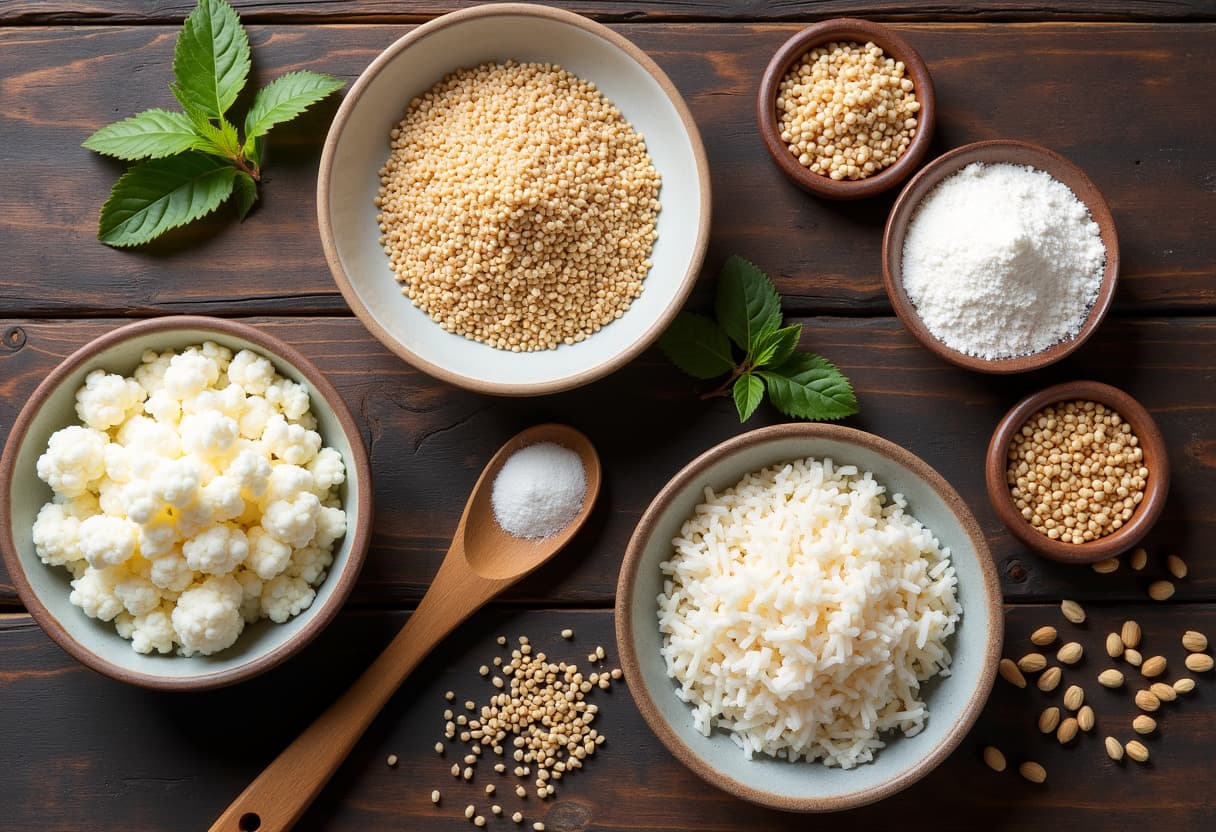
Grains are the trickiest food group on keto: even the "healthy whole grains" are mostly starch, so almost none fit a strict carb budget. Here's how the popular options stack up — and the swaps that actually work.
Almost all grains are too high-carb for keto. Cooked white rice has ~28g net carbs per 100g, whole-wheat bread ~41g, and oats ~12g per cooked 100g — a single normal serving of any of them can use or exceed a full 20g daily keto budget. The lowest-carb true grains are wild rice and barley, while pseudo-grains like quinoa (~18g) and buckwheat (~20g) are better than wheat but still not keto. For staying in ketosis, swap grains for cauliflower rice, shirataki, almond flour, and coconut flour instead.
Carb counts of common grains
Here are popular grains and pseudo-grains ranked by net carbs (total carbs minus fiber) per 100g, as commonly eaten (cooked for rice/oats/quinoa, dry for flours and cornstarch). "Keto-friendly?" flags whether it fits a strict 20–50g/day keto plan.
| Grain | Net carbs (per 100g) | Keto-friendly? |
|---|---|---|
| Cornstarch (dry) | ~91g | No |
| White flour (dry) | ~73g | No |
| White rice (cooked) | ~28g | No |
| Brown rice (cooked) | ~23g | No |
| Wild rice (cooked) | ~21g | No |
| Buckwheat groats (cooked) | ~20g | Limit |
| Quinoa (cooked) | ~18g | Limit |
| Couscous (cooked) | ~22g | No |
| Barley, pearled (cooked) | ~26g | No |
| Oats (cooked) | ~12g | Limit |
| Whole-wheat bread (1 slice, ~40g) | ~10g/slice | Limit |
| Polenta/cornmeal (cooked) | ~16g | No |
Numbers are approximate and vary by brand, variety, and preparation. Source: USDA FoodData Central (public domain).
Is buckwheat keto?
Buckwheat gets asked about constantly because it isn't actually wheat — it's a pseudo-grain (the seed of a flowering plant, related to rhubarb), it's naturally gluten-free, and it's higher in fiber and protein than refined grains. All of that makes it a smart pick for general low-carb eating.
But "low-carb friendly" and "keto" aren't the same thing. Cooked buckwheat groats (kasha) carry about 20g net carbs per 100g, and a real-world 1-cup serving (~170g) lands near 30g net carbs — more than an entire strict keto day. So the honest answer: buckwheat is better than wheat or white rice, fine on a liberal 50g+ low-carb plan in a small portion, but it will knock you out of strict ketosis if you eat a normal bowl. The same logic applies to quinoa (~18g/100g cooked).
Keto rice swaps
Rice is the grain most people miss, and it's one of the easiest to replace. White rice runs ~28g net carbs per 100g cooked, and a standard 1-cup serving is roughly 45g net carbs — more than double a strict keto budget in one side dish. The good news is that "keto rice" alternatives nail the texture for almost nothing:
| Rice swap | Net carbs (per 1 cup, ~150g) | Notes |
|---|---|---|
| Cauliflower rice | ~3g | Riced cauliflower; sautés or steams in minutes |
| Shirataki / konjac rice | ~0–1g | Glucomannan fiber; rinse well, dry-fry to firm up |
| Broccoli rice | ~4g | Riced broccoli florets; extra fiber and flavor |
| Riced cabbage | ~3g | Cheap, holds up in stir-fries |
| Cauliflower + a little real rice | varies | "Stretch" method to ease in |
Cauliflower rice is the workhorse — buy it riced or pulse florets in a food processor. Shirataki rice is the lowest-carb option of all, made from konjac fiber, and works well in fried-rice and burrito-bowl style dishes once you rinse and dry-fry it.
Is cornstarch keto?
No — cornstarch is one of the highest-carb ingredients in the kitchen. It's essentially pure starch at about 91g net carbs per 100g, which works out to roughly 7g net carbs per tablespoon. Thicken one pot of gravy or a stir-fry sauce and you can quietly spend a third of your daily carbs before the main course.
Keto thickeners do the same job without the carb hit:
- Xanthan gum — extremely powerful; use 1/4 to 1/2 teaspoon to thicken a whole sauce. Near-zero net carbs.
- Glucomannan (konjac) powder — similar thickening strength, also fiber-based.
- Psyllium husk — great for thickening and for binding baked goods.
- Cream, cream cheese, or a cheese reduction — thicken sauces by reducing fat-based liquids instead of adding starch.
A pinch of xanthan replaces a tablespoon of cornstarch, so start small and whisk to avoid clumps.
Best low-carb flours for baking
Grain flours are out (wheat flour ~73g net carbs/100g), but keto baking has matured around a few reliable nut- and fiber-based flours:
- Almond flour (~10g net carbs/100g, ~3g per 1/4 cup) — the all-purpose default for breads, cookies, and breading.
- Coconut flour (~21g net carbs/100g, but very absorbent so you use far less) — soaks up moisture; recipes need extra eggs and liquid.
- Ground flaxseed (~1.5g net carbs per 2 tbsp) — binds, adds fiber, and makes a quick "flax egg."
- Psyllium husk — adds chew and structure to keto breads, mimicking gluten.
- Lupin flour and oat fiber — useful low-net-carb add-ins for texture.
These don't behave 1:1 with wheat flour, so it's worth using a recipe written specifically for them rather than substituting by volume.
How to swap grains without missing them
You rarely crave the grain itself — you crave the role it plays (a base for sauce, bulk on the plate, something to soak up flavor). Match the job, not the ingredient:
- Rice and grain bowls → cauliflower rice or shirataki rice.
- Pasta and noodles → zucchini noodles, shirataki noodles, or hearts-of-palm pasta.
- Bread and wraps → almond-flour bread, cheese-based "chaffles," or lettuce/cabbage wraps.
- Oatmeal → "noatmeal" from chia, flax, and hemp hearts (~4–6g net carbs vs ~24g for a cooked cup of oats).
- Sauce thickeners → xanthan gum or a cream reduction instead of cornstarch or flour.
- Beer — literally fermented grain ("liquid bread" at ~11-13g per regular can) → a low-carb beer at 0-3g does the same job for a fraction of the budget.
Because swaps still carry a few carbs each, the carbs add up across a day. That's where CarbMeNot helps: search or snap a photo of your meal and it returns net carbs, fiber, and macros instantly, then subtracts them from your daily budget — so you can see whether that half-cup of quinoa actually fits before you eat it. For the full picture of what else to keep on hand, see our keto food list and the breakdown of what net carbs are.
Track your grain swaps in CarbMeNot
CarbMeNot is an AI-powered low-carb and keto tracker built to make decisions like these effortless. Type "cauliflower rice" or scan your plate and you'll get net carbs in a second, drawn from a verified food database, so you always know how much of your daily budget a swap costs. Download CarbMeNot and stop guessing whether a grain — or its replacement — fits your day.
(Comparing trackers first? Our best carb tracker apps roundup covers the free options.)
Key takeaways
- Nearly all grains are too high-carb for strict keto: white rice ~28g, brown rice ~23g, and whole-wheat bread ~41g net carbs per 100g.
- Buckwheat and quinoa are lower-carb pseudo-grains (~20g and ~18g/100g cooked) and better than wheat, but a normal serving still breaks a 20g keto budget — so "low-carb friendly," not strictly keto.
- Cornstarch is ~91g net carbs per 100g (~7g per tablespoon); use xanthan gum, glucomannan, or psyllium to thicken instead.
- Swap rice for cauliflower or shirataki rice, and wheat flour for almond or coconut flour, to keep net carbs in the low single digits.
- Swaps still carry a few carbs each, so tracking with CarbMeNot keeps the running total under your 20–50g daily keto limit.
Frequently asked questions
- What is the lowest-carb grain?
- Among true grains, wild rice (~21g net carbs per 100g cooked) and barley are at the lower end, but they're still too high for strict keto. Pseudo-grains like buckwheat (~20g) and quinoa (~18g) are lower than wheat or white rice, yet a normal serving still uses most of a 20g keto budget.
- Is buckwheat keto?
- Not really. Despite the name, buckwheat is a low-carb-friendly pseudo-grain only in tiny amounts — cooked buckwheat groats have about 20g net carbs per 100g, and a typical 1-cup (170g) serving runs near 30g net carbs. It's a better choice than wheat for low-carb eaters, but it will break a strict keto budget.
- Can you eat rice on keto?
- Regular rice doesn't fit keto: white rice has about 28g net carbs per 100g cooked and a 1-cup serving is ~45g. Use keto 'rice' swaps instead — cauliflower rice (~3g net carbs/cup), shirataki (konjac) rice (near 0g), or riced broccoli — which give you the same texture for a fraction of the carbs.
- Is cornstarch keto?
- No. Cornstarch is almost pure starch — about 91g net carbs per 100g, or roughly 7g net carbs per tablespoon. Even small amounts add up fast, so on keto use thickeners like xanthan gum, glucomannan, or psyllium husk, which thicken sauces with virtually no net carbs.
- What can I use instead of grains on keto?
- Swap grains for cauliflower rice, shirataki noodles, zucchini noodles, almond flour, coconut flour, and ground flax or psyllium for baking. These deliver the bulk, texture, and structure of grains while keeping net carbs in the low single digits per serving.
Sources
Keep reading
Free tools: Is It Keto? checker · macro calculator · protein calculator · 7-day meal plan PDF