Best Low-Carb & Keto Bread (Store-Bought + Homemade)
The best keto bread tops out around 0-2g net carbs per slice. Compare 18 store-bought and homemade options, with USDA-based net carbs and honest verdicts.

Editorial Team · June 20, 2026 · 7 min read
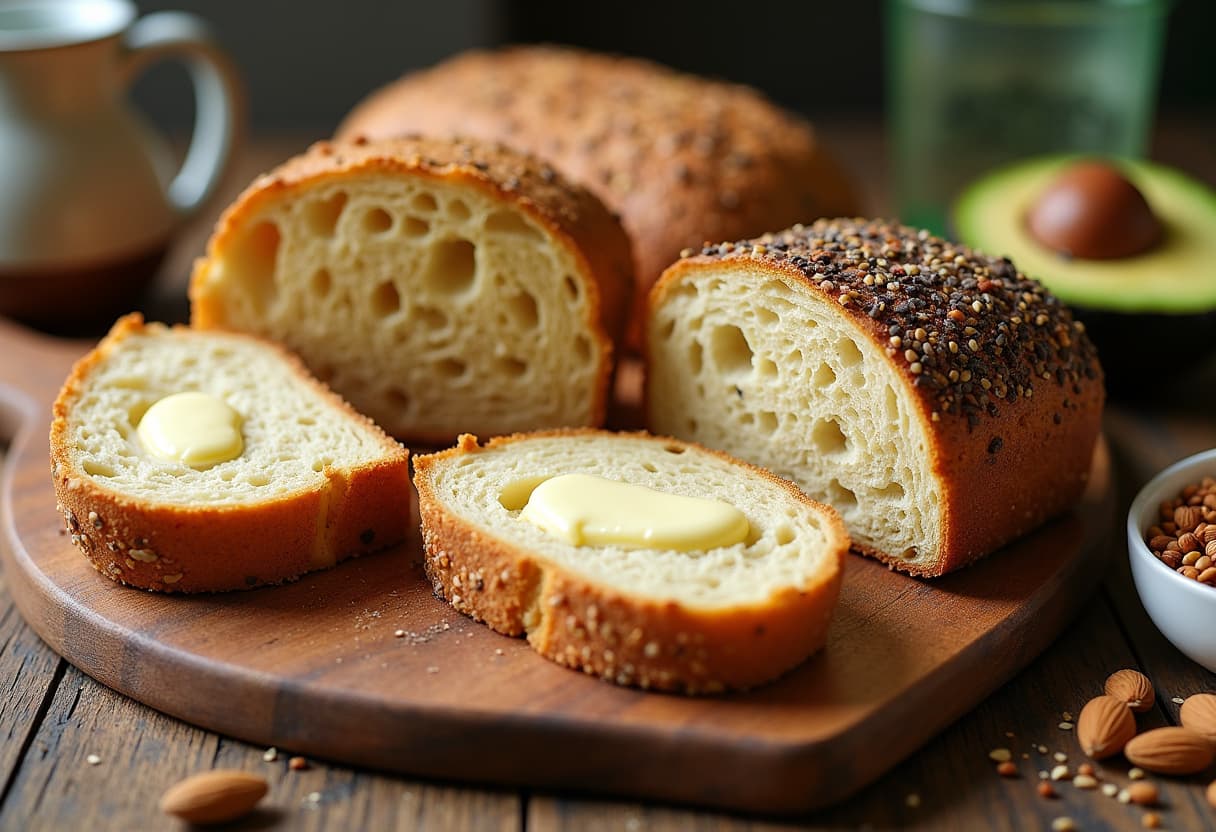
Bread is the food most people miss within a week of going keto, and it's the one the supplement aisle is most eager to "solve." The good news: a handful of store-bought loaves and two or three homemade recipes genuinely deliver real sandwich bread at 0-2g net carbs per slice. The bad news: at least half the loaves marketed as "low-carb" are nothing of the sort.
The best keto breads land between 0 and 2g net carbs per slice. Homemade wins outright: cloud (oopsie) bread is ~0.5g net carbs per piece and 90-second almond flour mug bread is ~2g. Among store-bought loaves, seeded wheat-protein breads (like Sola Deliciously Seeded) hit ~1g and plain wheat-protein loaves (Sola Sweet & Buttery, BFree) run ~2g, both with 4-5g protein per slice. Avoid the impostors — whole wheat (~11g), multigrain (~13g), sourdough (~15g), and "low-carb" loaves that are merely lower-carb. Treat any "0g net carbs" claim as "very low" and weigh your portion.
The ranked low-carb bread chart
Numbers are per the common serving shown, based on USDA FoodData Central and brand labels. Net carbs = total carbs − fiber − sugar alcohols. "Keto verdict" assumes a 20-30g net carb daily limit.
| Bread (serving) | Net carbs | Protein / Calories | Keto verdict |
|---|---|---|---|
| Cloud / oopsie bread (1 piece) | ~0.5g | 4g / 45 cal | Best — eat freely |
| Egg wraps / egg "tortilla" (1) | ~1g | 5g / 50 cal | Excellent |
| Sola Deliciously Seeded (1 slice) | ~1g | 5g / 45 cal | Excellent |
| Almond flour mug bread (1 slice) | ~2g | 6g / 90 cal | Excellent |
| Sola Sweet & Buttery (1 slice) | ~2g | 4g / 40 cal | Excellent |
| BFree keto/multiseed (1 slice) | ~2g | 4g / 60 cal | Excellent |
| Coconut flour keto loaf (1 slice) | ~2g | 5g / 110 cal | Excellent |
| ThinSlim Foods Plain (1 slice) | ~0g* | 7g / 45 cal | Great (verify portion) |
| Fat-head dough roll (1) | ~3g | 9g / 160 cal | Great |
| Base Culture keto loaf (1 slice) | ~3g | 4g / 90 cal | Good |
| Flaxseed / "psyllium" keto loaf (1 slice) | ~2-3g | 5g / 80 cal | Good |
| Lewis Bake Shop Healthy Life (1 slice) | ~3g | 4g / 35 cal | Good in 1-slice portions |
| Sprouted Ezekiel 4:9 (1 slice) | ~14g | 5g / 80 cal | Not keto |
| Pumpernickel (1 slice) | ~11g | 3g / 80 cal | Not keto |
| 100% whole wheat (1 slice) | ~11g | 4g / 80 cal | Not keto |
| Multigrain (1 slice) | ~13g | 4g / 90 cal | Not keto |
| Sourdough (1 slice, ~50g) | ~15g | 5g / 130 cal | Not keto |
| White sandwich (1 slice) | ~13g | 3g / 80 cal | Not keto |
*ThinSlim labels "0g net carbs" by subtracting all fiber; treat as "very low," not literally zero.
What actually makes bread low-carb?
Real keto bread replaces wheat flour with ingredients that are mostly fat, protein, and insoluble fiber. There are three honest building blocks:
- Almond flour — ~3g net carbs per quarter-cup, rich in fat and vitamin E. Makes the most "normal" loaf texture.
- Coconut flour — very absorbent, so recipes use little of it; ~4g net carbs per 2 tablespoons but high in fiber.
- Eggs + a fat (cream cheese, butter, mascarpone) — the base of cloud bread and fat-head dough, contributing essentially zero carbs.
Add psyllium husk or ground flax for structure and you get a loaf that slices, toasts, and holds a sandwich — all under 3g net carbs. Commercial keto loaves take a different route: vital wheat gluten (wheat protein isolate) plus resistant fibers. That's why a Sola or BFree slice tastes more like "real" bread but isn't gluten-free, and why a few people find these fibers nudge their blood sugar where almond-flour bread doesn't.
The impostors: breads people think are keto but aren't
This is where most "low-carb bread" guides quietly mislead. The following are marketed with health halos but are not keto:
- Whole wheat & multigrain (~11-13g net carbs/slice). "Whole grain" describes the flour, not the carb load. Two slices for a sandwich is 22-26g — your entire daily budget, before fillings.
- Sourdough (~15g/slice). The fermentation story is real and may slightly lower glycemic impact, but a slice still carries ~15g net carbs. It is lower-glycemic bread, not low-carb bread.
- Ezekiel / sprouted grain (~14g/slice). Genuinely nutritious and high-fiber, but sprouting doesn't remove the starch. Great on a moderate-carb diet, not keto.
- Rye & pumpernickel (~11g/slice). Lower glycemic than white bread, but still firmly grain-based.
- "Lower-carb" or "carb-smart" supermarket loaves (5-9g/slice). These cut carbs partway. Useful on a 100g/day low-carb plan; too high to eat freely on keto.
A simple rule: if the package brags about whole grains rather than printing a net-carb number on the front, it isn't keto.
Best store-bought picks (and how to read the label)
For convenience, three categories cover almost everyone:
- Wheat-protein loaves (Sola, BFree, ThinSlim) — closest to real bread, ~1-3g net carbs, 4-7g protein per slice. Best for daily sandwiches. Not gluten-free.
- Almond/coconut-flour loaves (Base Culture, various keto brands) — gluten-free, higher calorie (90-110 cal/slice), ~2-3g net carbs. Best for grain and gluten avoiders.
- Wraps & egg-based products — egg wraps and cloud-bread-style rounds at ~1g, ideal for tacos, roll-ups, and burgers.
When you read a label, do the math yourself: total carbs minus fiber minus sugar alcohols. Watch for IMO (isomalto-oligosaccharide) and chicory root fiber — they're counted as fiber but are partially digestible, so a "0g net carb" slice may behave like 1-2g in your body. And always check the serving weight: a 22g "thin" slice and a 45g standard slice can both claim "2g net carbs," but you'll eat twice the carbs with the heavier one.
The three homemade breads worth making
Homemade is cheaper, gluten-free, and the lowest-carb of all. Master these and you'll never buy a loaf:
- Cloud (oopsie) bread — ~0.5g net carbs/piece. Whip egg whites, fold in cream cheese and yolks, bake into rounds. Best for burger buns and open-faced sandwiches. No flour at all.
- 90-second almond flour mug bread — ~2g net carbs/slice. Almond flour, egg, melted butter, baking powder; microwave in a mug, then slice and toast. Fastest real-bread fix on keto.
- Fat-head dough — ~3g net carbs/roll. Mozzarella, cream cheese, almond flour, egg. Doubles as pizza crust, bagels, and rolls; the sturdiest, most bread-like texture you can make.
Practical serving and buying tips
- Toast it. Almond- and coconut-flour breads firm up dramatically when toasted, fixing the slightly damp texture of fresh keto bread.
- Portion to your budget. One 2g slice barely registers; a six-slice "snack" of 0g-labeled bread can still add 6-10g of real carbs. Weigh and log it.
- Freeze homemade loaves pre-sliced — keto breads stale fast without preservatives.
- Pair fat and protein, not more bread, to feel full: avocado, eggs, cheese, deli meat.
- Test your glucose once with any new commercial loaf, especially fiber-heavy ones.
The fastest way to keep bread in your keto life without blowing past your limit is to log it. Drop your slice — store-bought or homemade — into CarbMeNot, see the real net carbs against your daily budget, and add a glucose note if you're testing a new brand. Track a few options for a week and you'll know exactly which bread earns a permanent spot in your kitchen.
Frequently asked questions
- What is the lowest-carb bread you can buy?
- Among store-bought options, Sola Sweet & Buttery and similar wheat-protein loaves run about 2g net carbs per slice, while seeded varieties hit roughly 1g. Homemade beats all of them: cloud (oopsie) bread is about 0.5g net carbs per piece, and a 90-second almond flour mug bread is around 2g. Anything labeled 0g net carbs is rounding down from fiber-heavy fine print, so weigh your portion.
- Is whole wheat or multigrain bread keto?
- No. A single slice of whole wheat or multigrain bread carries about 11-15g net carbs, and most sandwiches use two slices, so you're spending 22-30g net carbs before any filling. On a 20-30g daily keto budget that's your entire allowance. 'Whole grain' and 'multigrain' describe the flour, not the carb count — they are not low-carb.
- Are keto breads with a lot of fiber actually zero net carbs?
- Sometimes the label overstates it. Net carbs = total carbs minus fiber (and sugar alcohols), and brands subtract every gram of added fiber and isomalto-oligosaccharides (IMO) to reach a tiny number. Some of those fibers are partially digestible and can still raise blood sugar in sensitive people. Treat '0g net carbs' as 'very low,' test your own glucose response, and stick to one or two slices.
- Does keto bread spike blood sugar?
- Real almond- and coconut-flour breads barely move glucose because they're mostly fat, protein, and insoluble fiber. Wheat-protein commercial loaves are usually fine in one-slice portions but contain vital wheat gluten and resistant fibers that affect some people. The only way to know your response is to test 1-2 hours after eating; CarbMeNot lets you log the slice and pair it with a glucose note.
- Can you eat bread every day on keto?
- You can if you account for it. One slice of true keto bread (0-2g net carbs) fits easily into a 20-30g daily limit, so a daily sandwich on two 2g slices costs only 4g net carbs. The risk isn't the carbs — it's using bread to recreate a high-volume grain habit. Keep it to a slice or two and let whole foods carry the meal.
Sources
Keep reading
Free tools: Is It Keto? checker · macro calculator · protein calculator · 7-day meal plan PDF