We Analyzed the Net Carbs in 3,266 Foods. Only 28% Fit a Keto Day
A data study of 3,266 common foods: the median food packs 17.9g net carbs per 100g, just 9% are near-zero-carb, and 'natural' foods like dried fruit and honey rank among the highest. Full numbers, methodology, and a cite-this dataset.

Editorial Team · July 8, 2026 · 9 min read
Last updated September 15, 2026
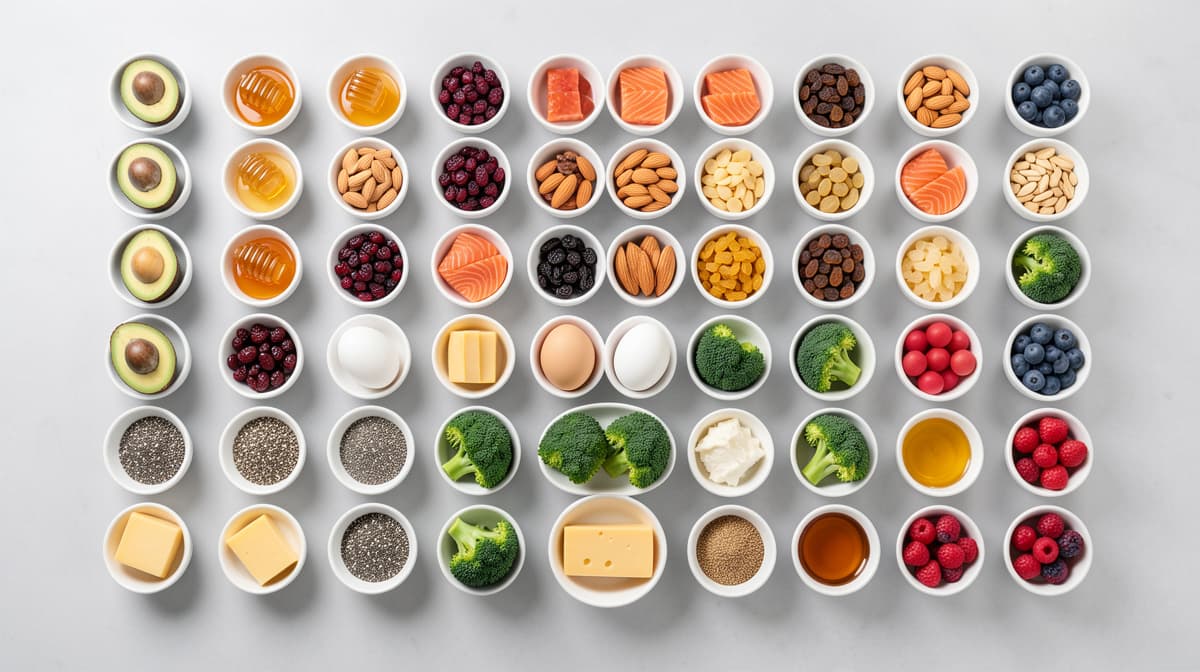
We run a net-carb food database, so we had a question we could actually answer with data: out of the everyday foods people look up, how many actually fit a low-carb day — and where do the hidden carbs hide?
So we analyzed the net carbs in 3,266 common foods — whole foods, packaged products, and restaurant items, all normalized to per-100-gram values from USDA and Open Food Facts data. Here is what the numbers say.
The headline: only 28% of foods fit a keto day
Of 3,266 foods analyzed, just 901 (28%) came in low enough in net carbs to fit comfortably in a keto day. Nearly 3 in 4 everyday foods (72%) did not. That single number explains why low-carb eating feels restrictive at first: most of the food landscape, by count, is carb-forward.
It gets starker when you look at the middle of the distribution:
| Metric | Net carbs (per 100g) |
|---|---|
| Median food | 17.9 g |
| Mean food | 26.9 g |
| Foods at or below 1g (near-zero) | 9% |
| Foods under 5g | 22% |
| Foods under 10g | 33% |
| Foods under 20g | 53% |
A strict keto day targets roughly 20g of net carbs. The median food carries 17.9g in just 100 grams — often a third of a cup, or a few bites. In other words, the typical single food nearly maxes out a full day's carb budget in one small serving. That is the math behind why portion size matters so much on low-carb, and why "a little bit" of the wrong food isn't little at all.
The full shape of the food landscape
Here's the complete distribution — every food in the dataset, bucketed by net carbs per 100g (updated 2026-08-11 on the same cleaned dataset):
| Net carbs per 100g | Foods | Share |
|---|---|---|
| 0–1g ("eat freely") | 284 | 9% |
| 1–5g | 447 | 14% |
| 5–10g | 350 | 11% |
| 10–20g | 644 | 20% |
| 20–40g | 622 | 19% |
| 40–60g | 461 | 14% |
| 60g+ | 458 | 14% |
Two numbers in that table deserve to be pulled out. 47% of all foods carry 20g+ of net carbs per 100g — meaning 100 grams of nearly half the food supply blows an entire strict-keto day on its own. And 21% carry 50g+, enough to bust even the most liberal low-carb budget. The food landscape isn't mildly tilted toward carbs; it's bimodal — a small safe harbor at the bottom, a large sugar-and-starch shelf at the top, and the everyday middle where the portion math gets decided. (Run any label through our free net carbs calculator to see where a food lands.)
The "eat freely" list is small — and it's mostly meat
Only 293 foods (9%) came in at 1g net carbs or less per 100g — the foods you can eat without really doing math. When we sorted that near-zero group by type, it was overwhelmingly animal protein:
| Category | Share of the near-zero (≤1g) foods |
|---|---|
| Meat & poultry | 43% |
| Fish & seafood | 8% |
| Eggs | 6% |
| Fats & oils | 3% |
| Cheese & dairy | 2% |
| Vegetables & greens | 1% |
This matches the lived experience of low-carb dieters: the truly "free" foods are meat, fish, eggs, and fat. Leafy greens are low-carb, but they don't show up as near-zero per 100g — you just eat them in volumes small enough that it never matters.
The most misleading foods: the "health halo" sugar bombs
The foods that surprise people most aren't candy — they know candy is sugar. It's the "natural," "wholesome," or "diet" foods that quietly rank among the highest net-carb items in the entire dataset:
| Food | Net carbs (per 100g) | Also known for |
|---|---|---|
| Honey | 82 g | "natural sweetener" |
| Dried cranberries | 77 g | "healthy snack / salad topper" |
| Dried mango | 76 g | "just fruit" |
| Raisins | 72 g | "natural, fat-free" |
| Maple syrup | 67 g | "natural sweetener" |
| Granola | 45 g | "health food" |
By weight, honey and dried fruit are closer to pure sugar than to a "snack." A quarter-cup of raisins can carry more net carbs than a full strict-keto day allows. The lesson isn't that these foods are evil — it's that the front-of-package vibe ("natural," "fat-free," "made with real fruit") has nothing to do with the net-carb number.
Net carbs vs. total carbs: for whole foods, the gap is huge
Net carbs subtract fiber (and sugar alcohols) from total carbs, because fiber isn't digested into blood glucose. For fibrous whole foods, that subtraction is enormous — and it's why counting total carbs makes keto look harder than it is:
| Food | Total carbs | Fiber | Net carbs | Drop |
|---|---|---|---|---|
| Flaxseed | 28.9 g | 27.3 g | 1.6 g | −94% |
| Chia | 42.1 g | 34.4 g | 7.7 g | −82% |
| Avocado | 8.5 g | 6.7 g | 1.8 g | −79% |
| Almonds | 21.6 g | 12.5 g | 9.1 g | −58% |
An avocado looks like an 8.5g "carb" food on a total-carb tracker and a 1.8g food on a net-carb one. Same avocado. This is the single biggest reason we built the database around net carbs: total carbs systematically penalize the exact whole foods a low-carb diet is built on.
The protein bargains: 195 foods with 15g+ protein and ≤2g net carbs
For anyone tracking protein as hard as carbs (which, on low-carb, should be everyone), we cut the data the other way: foods delivering at least 15g of protein per 100g while staying at or under 2g net carbs. There are 195 of them — just 6% of the dataset — and they're the backbone of every successful low-carb day. Clean standouts per 100g: steelhead trout (77g protein / 0g net), pork rinds (61g / 0g), chicken breast (32g / 0g), Swiss cheese (~32g / 0g), and bacon (~35–38g / ~1g). If you're aiming for a target from our protein calculator, this 6% of foods is where the grams come from without spending your carb budget.
The drinks aisle is friendlier than the pantry
One cut surprised us. We isolated 116 alcoholic and adult-beverage items (beers, seltzers, wine, spirits, cocktails). Their median was just 3.3g net carbs per 100g — roughly one-fifth of the all-food median — and 34% came in at 2g or under. Distillation and fermentation strip carbs the way "healthy" processing never does: the hard part of drinking low-carb isn't the alcohol, it's the mixers, juices, and sugary chasers around it. (Per-100g values; remember a 12-oz can is ~355g, so multiply accordingly — full breakdowns in our low-carb beer and hard seltzer guides.)
One more sugar note across the whole dataset: in 38% of carb-containing foods, sugar alone accounts for at least half of the net carbs. For most of the food supply, "watching carbs" and "watching sugar" are nearly the same activity.
Eating out is the hard mode: 89% of chain items don't fit
We isolated 460 restaurant and fast-food chain items in the dataset. The median was 20.9g net carbs, and only 11% qualified as keto-friendly. Put differently: order a typical item off a typical chain menu and there's roughly a 9-in-10 chance it doesn't fit a keto day as served — before you account for buns, breading, sauces, and sides. The keto-at-a-restaurant playbook (skip the bun, swap fries for a side salad, watch the sauce) exists because the default menu is stacked against you.
Why this matters
Three practical takeaways fall out of the data:
- Count net carbs, not total carbs. For whole foods the difference is 50–90%, and total-carb counting will talk you out of foods (avocado, chia, flax, nuts) that are actually low-carb staples.
- Distrust the health halo. "Natural" and "fat-free" are marketing, not macros. Dried fruit, honey, granola, and syrup are among the highest net-carb foods that exist.
- Portion is the whole game. When the median food carries ~18g net carbs per 100g and a keto day is ~20g, the difference between "in ketosis" and "out" is often just how much, not what. That's the practical case for tracking with an app that puts net carbs first — we compare the field honestly in our carb counter apps roundup.
Methodology
We started from CarbMeNot's food database (3,442 items sourced from USDA FoodData Central and Open Food Facts, with net carbs computed as total carbohydrate minus fiber and sugar alcohols). For this analysis we kept only items reported on a per-100-gram basis, removed duplicates by name, and excluded records with implausible values (net or total carbs outside 0–100g per 100g), leaving 3,266 foods. "Keto-friendly" reflects each food's net carbs per 100g being low enough to fit a 20–50g daily budget at a normal serving. Aggregate statistics (median, mean, percentiles) are robust to individual data-entry noise; specific foods cited were spot-checked against source values. Nutrition data are estimates and this is general information, not medical or dietary advice — see our Medical Disclaimer.
Cite this study
CarbMeNot Net-Carb Food Study (2026, updated Aug 2026). Analysis of 3,266 foods (USDA FoodData Central + Open Food Facts), normalized per 100g. Key findings: only 28% of foods are low enough in net carbs to fit a keto day; the median food contains 17.9g net carbs per 100g; 47% of foods carry 20g+ per 100g (a full strict-keto day in one serving); 9% are near-zero (≤1g); just 6% (195 foods) pair 15g+ protein with ≤2g net carbs; alcoholic beverages run a median of 3.3g/100g — one-fifth of the all-food median; and "natural" foods such as honey (82g), dried cranberries (77g), and raisins (72g) rank among the highest net-carb foods measured. Source: https://www.carbmenot.com/blog/net-carbs-3266-foods-study
Download the dataset
The full analysis dataset is free to download and reuse with attribution (CC BY 4.0):
Download the CSV — 3,266 foods, per-100g values (name, source item, calories, total carbs, fiber, sugar, sugar alcohols, net carbs, protein, fat, keto-friendly flag).
Journalists, dietitians, and bloggers are welcome to cite these figures with a link. Want a specific cut of the data (a category, a chain, a food group) for a story? Email us at hello@carbmenot.com and we'll pull it. You can also explore the underlying numbers yourself in our free net-carb food database or check any single food with the Is It Keto? tool.
Frequently asked questions
- How many common foods are actually keto-friendly?
- In our analysis of 3,266 foods, only 28% (901 foods) came in low enough in net carbs to fit comfortably in a keto day — meaning nearly 3 in 4 everyday foods do not. Keto-friendliness here means a food's net carbs per 100g are low enough that a normal serving fits within a 20–50g daily net-carb budget without dominating it.
- What is the average net carb content of food?
- Across 3,266 foods measured per 100 grams, the median food contains 17.9g of net carbs and the mean is 26.9g. Because a strict keto day targets about 20g of net carbs, the median single food nearly uses a full day's budget in just 100 grams — roughly a third of a cup for many foods.
- Which 'healthy' foods are secretly high in carbs?
- The biggest offenders in our data were dried fruits and 'natural' sweeteners: honey (82g net carbs per 100g), dried cranberries (77g), dried mango (76g), raisins (72g), maple syrup (67g), and granola (45g). These are marketed as natural or wholesome but are close to pure sugar by weight, so they blow through a keto or low-carb budget fast.
- How many high-protein, zero-carb foods are there?
- Only 195 of the 3,266 foods we analyzed (6%) deliver at least 15g of protein per 100g while staying at or under 2g of net carbs — foods like steelhead trout, chicken breast, pork rinds, and Swiss cheese. That small slice of the food supply is where low-carb dieters get their protein without spending their carb budget.
- Is alcohol high in carbs?
- Less than most food. Across 116 alcoholic and adult beverages in our data, the median was just 3.3g of net carbs per 100g — about one-fifth of the all-food median — and 34% came in at 2g or under. Spirits are near zero; the carbs in drinking come mostly from mixers, juice, and sweet chasers.
- Why are net carbs lower than total carbs?
- Net carbs subtract fiber (and sugar alcohols) from total carbohydrates, because fiber is not digested into blood glucose. For high-fiber whole foods the difference is large: flaxseed drops 94% from total to net carbs, chia 82%, and avocado 79%. That is why total-carb counts overstate how much a fibrous food actually affects ketosis.
Sources
Keep reading
Free tools: Is It Keto? checker · macro calculator · protein calculator · 7-day meal plan PDF