Steel-Cut vs Rolled Oats: Carbs, GI & Which Is Healthier
Steel-cut and rolled oats have identical macros — about 27 g carbs and 4 g fiber per serving. Steel-cut's lower GI (~52 vs 55–60) is the only real edge.

Editorial Team · July 2, 2026 · 6 min read
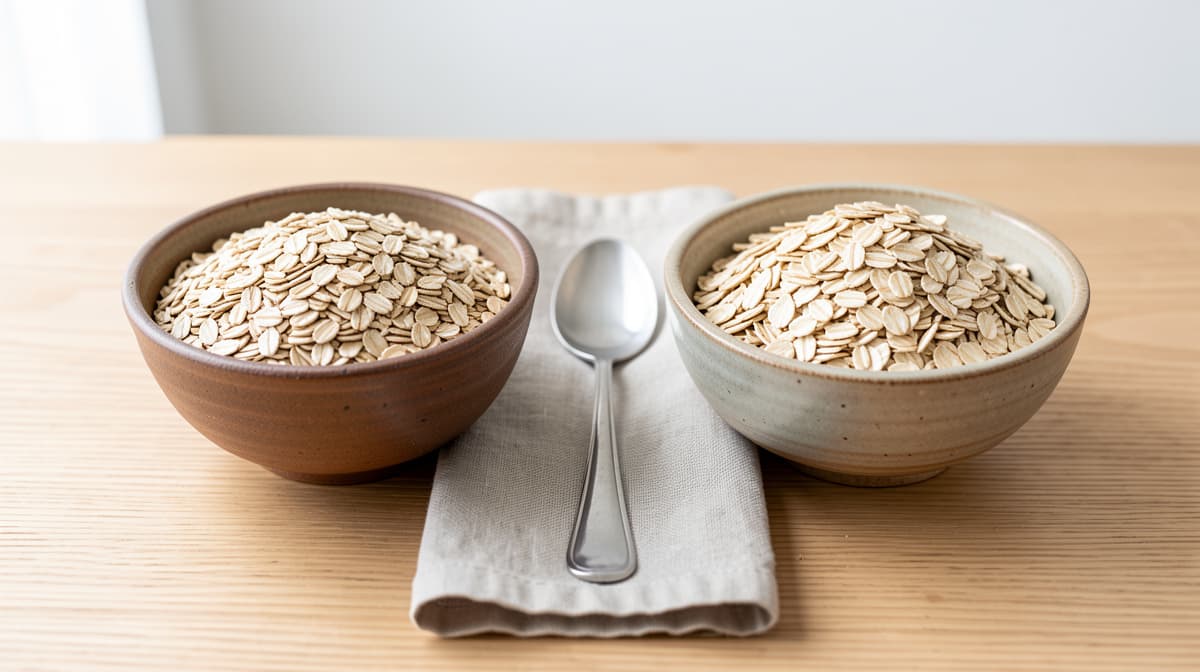
Steel-cut and rolled oats come from the same whole oat groat, and their nutrition is nearly identical: about 150 calories, 27 g total carbs, 4 g fiber, and 5 g protein per 40 g dry serving. The real differences are texture, cook time, and glycemic index — steel-cut sits around 52–55 versus 55–60 for rolled — a modest blood-sugar edge, not a nutritional one. Neither is low-carb: a standard bowl delivers roughly 23 g net carbs.
Quick comparison table
Values are per 40 g dry serving (about 1/4 cup steel-cut or 1/2 cup rolled — both cook into one standard bowl), based on USDA-typical data:
| Nutrient | Steel-cut oats | Rolled (old-fashioned) oats |
|---|---|---|
| Calories | 150 | 150 |
| Total carbs | 27 g | 27 g |
| Fiber | 4 g | 4 g |
| Net carbs | 23 g | 23 g |
| Protein | 5 g | 5 g |
| Fat | 2.5 g | 3 g |
| Glycemic index | ~52–55 | ~55–60 |
| Cook time | 20–30 min | 5–10 min |
Any differences you spot on packages are rounding and serving-size artifacts, not real nutritional gaps.
What's actually different between steel-cut and rolled oats?
Both start as oat groats — the whole kernel with the fibrous bran, the fat- and vitamin-rich germ, and the starchy endosperm still intact after only the inedible hull is removed. From there the paths split.
Steel-cut oats (also called Irish or pinhead oats) are groats chopped into two or three pieces with steel blades. That's the entire process. Rolled oats (old-fashioned oats) are groats that get steamed to soften them, pressed flat between heavy rollers, and lightly toasted. Quick oats are rolled thinner and chopped smaller, and instant oats are pre-cooked, dried, and rolled thinnest of all.
Here's the point most articles bury: none of these steps remove anything. No bran is stripped, no germ is discarded. Every cut of oats — steel-cut through plain instant — is a 100% whole grain with the same macros gram for gram. Per 100 g dry, USDA data puts both at roughly 375–380 calories, 67–68 g carbohydrate, 10 g fiber (so about 57–58 g net carbs), 13 g protein, and 6.5 g fat.
What processing does change is surface area and starch structure, and that shows up in three places: texture (steel-cut cooks up chewy and almost pilaf-like; rolled cooks creamy and soft), cook time (steel-cut needs 20–30 minutes on the stove; rolled needs 5–10), and digestion speed, which we'll get to next. Rolled oats also win on versatility — they soften in cold liquid for overnight oats and work in granola, cookies, and smoothies, while steel-cut stays gravelly unless fully cooked (an overnight soak cuts its cook time roughly in half).
Do steel-cut oats really spike blood sugar less?
Somewhat — but the gap is smaller than the health halo suggests. In glycemic index testing, steel-cut oats typically land around 52–55, old-fashioned rolled oats around 55–60, and instant oats jump to about 79. The larger the flake's surface area and the more the starch has been pre-gelatinized by steaming, the faster your digestive enzymes convert it to glucose.
Translate GI into glycemic load — which accounts for the actual carbs in a serving — and a bowl of steel-cut comes in around 13–14 versus 15–16 for rolled. Both fall in the "moderate" band. Steel-cut is the slower carb, but it is not a slow carb.
Three levers move your glucose response more than the steel-cut-versus-rolled choice:
- Cooking time and texture. The longer and softer you cook any oat, the higher its effective GI. Steel-cut simmered into soft porridge for 45 minutes loses much of its advantage.
- What you pair it with. Protein and fat — a couple of eggs on the side, a scoop of Greek yogurt, a tablespoon of peanut butter — blunt the glucose curve more than swapping cuts does.
- What you top it with. A tablespoon of brown sugar or honey adds 12–17 g of fast-digesting carbs and swamps any GI difference between cuts.
One genuine tie worth celebrating: beta-glucan, the soluble fiber behind oats' LDL-cholesterol-lowering effect, runs about 4 g per 100 g dry in both. The FDA heart-health claim threshold of 3 g per day is reachable with either — equally.
So which one is actually healthier?
Honestly, it's close to a tie, and anyone declaring a decisive winner is overselling.
The case for steel-cut: a slightly lower GI, and a chewier texture that slows eating — chewing time and eating rate measurably affect fullness, so some people genuinely stay satisfied longer on steel-cut. If you have prediabetes, wear a CGM, or just watch your glucose and still want oats in your life, steel-cut plus a protein pairing is the better-behaved version.
The case for rolled: it cooks in a fraction of the time, works cold in overnight oats and in baking, is usually cheaper per serving, and — not trivially — a breakfast you'll actually make beats a theoretically better one that stays in the pantry. Micronutrients are a wash: both are good sources of manganese, phosphorus, magnesium, zinc, iron, and thiamin.
The real dividing line in the oatmeal aisle isn't steel-cut versus rolled — it's plain versus flavored instant. A flavored instant packet typically adds 8–13 g of sugar and carries the highest GI of any oat product. If you're deciding between plain steel-cut and plain rolled, you've already made the choice that matters.
Can oats fit a low-carb or keto diet?
This is where both cuts hit the same wall. Net carbs are total carbs minus fiber (minus sugar alcohols too, though plain oats contain none). A standard 40 g dry serving of either oat works out to 27 g total − 4 g fiber = 23 g net carbs — before milk, fruit, or sweetener.
On keto, where most people target 20–50 g net carbs per day, one plain bowl can consume the entire daily budget at the strict end. Steel-cut offers no discount here; the carbs are identical, just slightly slower.
That doesn't have to mean zero oats, but it does mean honest portions:
- Keto (20–30 g net/day): 1–2 tablespoons dry (10–15 g) is about 6–9 g net carbs — enough to add real oat texture to a "noatmeal" base of hemp hearts, chia, and flax, which itself runs only 3–5 g net carbs per bowl.
- Moderate low-carb (50–100 g net/day): a half portion — 20 g dry, roughly 11–12 g net carbs — with protein alongside is workable most days.
One tracking trap worth flagging: oats roughly triple in weight when cooked, so 40 g dry becomes about 240 g of cooked oatmeal. Weigh your portion dry, or make sure the database entry you log explicitly says "cooked." Logging 240 g of cooked oatmeal against a dry-oats entry would record around 138 g net carbs — a sixfold error, and one of the most common logging mistakes we see.
The bottom line
Steel-cut and rolled oats are the same whole grain in different shapes: identical calories, carbs, fiber, protein, and beta-glucan per gram. Steel-cut earns a real but modest win on glycemic index (roughly 52–55 vs 55–60) and chew; rolled wins on speed, price, and versatility. Pick by texture and schedule, skip the sweetened instant packets, and watch your toppings — they move your blood sugar more than the cut does. And if you eat low-carb, treat any oatmeal as a measured indulgence: at 23 g net carbs per bowl, portion size — not oat type — is the whole game.
Frequently asked questions
- Are steel-cut oats lower in carbs than rolled oats?
- No. Both come from the same whole groat, so a 40 g dry serving of either has about 27 g total carbs, 4 g fiber, and 23 g net carbs. Processing changes shape and digestion speed, not carb content — any label differences are rounding or serving-size artifacts.
- Which oats are better for blood sugar?
- Steel-cut, modestly. Its glycemic index is around 52–55 versus 55–60 for rolled oats and about 79 for instant. But both are moderate-GI foods, and pairing oats with protein and fat — or skipping sugary toppings — affects your glucose response more than the cut you choose.
- Can I eat oatmeal on keto?
- Barely. A standard bowl (40 g dry) has about 23 g net carbs, which can use a strict keto day's entire 20–30 g budget. Most keto eaters either use 1–2 tablespoons of oats (6–9 g net carbs) as texture in a hemp-chia-flax "noatmeal," or skip oats and use those substitutes at 3–5 g net carbs per bowl.
- Do steel-cut oats have more fiber than rolled oats?
- Essentially no. Both provide about 10 g fiber per 100 g dry (about 4 g per serving), including roughly 4 g of cholesterol-lowering beta-glucan per 100 g. Nothing is removed when oats are steamed and rolled, so the fiber, protein, and micronutrients stay the same.
Keep reading
Free tools: Is It Keto? checker · macro calculator · protein calculator · 7-day meal plan PDF