Protein Oatmeal: How to Make It + 6 Ways to 30g
Plain oatmeal has just 5g protein per bowl. Get to 30g with whey (+20-25g), egg whites (+10g), cottage cheese (+12g), and more — exact gram counts inside.

Editorial Team · July 2, 2026 · 7 min read
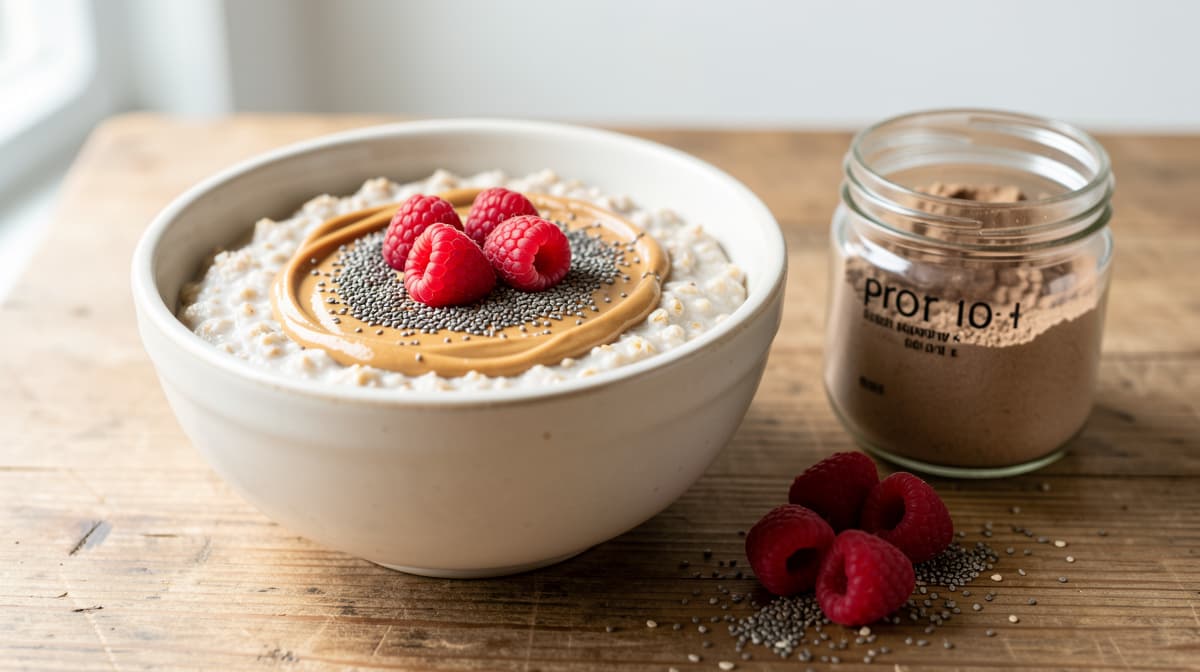
Plain oatmeal isn't a protein food. A bowl made from 1/2 cup of rolled oats delivers about 5 grams of protein and 150 calories — plenty of carbs, not much staying power. To reach 30 grams, you have two basic moves: stir a scoop of whey or casein in after cooking (+20–25 g), or stack smaller upgrades — egg whites (+10 g), Greek yogurt (+10–12 g), cottage cheese (+12 g), milk instead of water (+8 g) — until the math works.
What does the base recipe look like?
Start with the standard bowl, because every number below builds on it:
- 1/2 cup rolled oats (40 g dry)
- 1 cup liquid (water, milk, or a mix)
- Pinch of salt
Simmer 5 minutes on the stove, or microwave 2 to 2 1/2 minutes in a deep bowl (oats boil over in shallow ones). That base bowl comes to roughly 150 calories, 27 g carbs, 4 g fiber, 3 g fat, and 5 g protein. Steel-cut and quick oats are nutritionally almost identical per gram — the difference is texture and cook time, not macros.
Five grams is the problem. Most research on muscle retention and satiety points to 25–40 g of protein per meal as the useful range, especially at breakfast, when most Americans eat the least protein of the day. Everything below is about closing that 25-gram gap.
How much protein does each add-in actually bring?
Here's the honest math, using standard amounts. Numbers vary a little by brand, so check your labels — but these are good working figures.
| Add-in | Amount | Protein added | Calories added |
|---|---|---|---|
| Whey or casein powder | 1 scoop (~30 g) | +20–25 g | ~110–130 |
| Liquid egg whites | 1/3–1/2 cup | +9–13 g | ~45–65 |
| Nonfat Greek yogurt | 1/2 cup | +10–12 g | ~65 |
| Cottage cheese (2%) | 1/2 cup | +12–14 g | ~90 |
| Milk instead of water | 1 cup | +8 g (+13 g ultra-filtered) | ~120 |
| Peanut butter / hemp hearts / chia | 2 tbsp / 3 tbsp / 2 tbsp | +7 / +10 / +4 g | ~190 / 170 / 140 |
1. Whey or casein stirred in (+20–25 g)
The fastest route: one scoop turns a 5-gram bowl into a 25–30-gram bowl, done. Whey makes oats slightly thinner; casein makes them noticeably thicker, almost like pudding, so add an extra splash of milk. Timing matters — see the section below.
2. Egg whites cooked in (+10 g)
Whisk 1/3 cup of carton egg whites (about 9 g protein) into the oats during the last 2–3 minutes of cooking, stirring constantly so they incorporate instead of scrambling. A full 1/2 cup gets you closer to 13 g. The payoff besides protein: egg whites make oatmeal fluffy and almost double the volume, with zero egg flavor. Best trick on this list for big-bowl eaters on a calorie budget — 1/2 cup adds only about 60 calories.
3. Greek yogurt (+10–12 g)
Stir 1/2 cup of nonfat Greek yogurt in after the oats come off the heat (a minute of cooling keeps it from thinning out). It adds creaminess and a slight tang that works well with berries and cinnamon. Also the natural protein base for overnight oats — no cooking involved.
4. Cottage cheese blend (+12 g)
The highest-protein dairy option per calorie: 1/2 cup of 2% cottage cheese adds 12–14 g for about 90 calories. If the curds put you off, blend the cottage cheese smooth first (10 seconds in a blender) — it disappears completely into the oats and just reads as "creamy." Slightly salty, so it leans savory or pairs well with banana and cinnamon.
5. Milk instead of water (+8 g)
The zero-effort upgrade. Cooking your oats in 1 cup of dairy milk instead of water adds 8 g of protein; ultra-filtered milk (Fairlife-style) adds 13 g with about half the sugar. Soy milk adds about 7 g. Almond milk adds roughly 1 g — it changes the flavor, not the protein, so don't count it toward your 30.
6. Nut butter, hemp, or chia (+4–10 g)
Two tablespoons of peanut butter add about 7 g of protein — along with 190 calories, mostly fat. Three tablespoons of hemp hearts add roughly 10 g of complete protein for 170 calories. Two tablespoons of chia add only 4 g of protein but about 10 g of fiber and serious thickening power. These are finishers, not the main event: great if you're bulking or need the bowl to hold you for five hours, worth measuring carefully if you're cutting.
When should you add protein powder — before or after cooking?
After cooking, once the oats have cooled for a minute or two. Whey stirred into oats before or during cooking clumps into grainy, chalky lumps, because whey proteins denature and aggregate above roughly 160°F. To be clear, this is a texture problem, not a nutrition problem — denatured protein has the same amino acids, and your stomach denatures protein anyway. Cooked whey still "counts." It just tastes worse.
The clean method: cook the oats, pull them off the heat, wait 60–90 seconds, then stir in the scoop. If you still get clumps, whisk the powder into a splash of cold milk first and stir that slurry in. Casein tolerates heat better and thickens as it hydrates, which many people actually prefer in hot oats. For overnight oats, either powder works fine since nothing is heated — casein gives you the thickest result.
How many carbs are really in this bowl?
Here's the part most protein-oatmeal articles skip. That 1/2 cup of oats carries 27 g of total carbs, or about 23 g net after fiber. Toppings move fast from there: a medium banana adds another 24 g, a tablespoon of honey 17 g. A typical fruit-topped bowl lands at 40–60 g of total carbs — completely reasonable for most active people, especially before or after training, but worth knowing if you're logging your food rather than guessing.
If you're eating low-carb or keto, a full bowl simply doesn't fit: 23 g net is most of a strict keto day's budget on its own. The workable compromise is the small-portion "proats" build — 1/4 cup of oats (about 12 g net carbs, 75 calories, 2.5 g protein) bulked back up with a scoop of whey and 1/4 cup of egg whites. The protein powder and egg whites restore the volume and creaminess the missing oats took away, and you end up with a 30-plus-gram protein bowl at roughly 14 g net carbs — a real oatmeal experience that still leaves room in a moderate low-carb day.
Which combos actually hit 30 grams?
Three builds that clear the bar, depending on what's in your kitchen:
- Fastest (~30 g, ~280 calories): 1/2 cup oats in water + 1 scoop whey stirred in after cooking.
- No powder (~30 g, ~460 calories): 1/2 cup oats cooked in 1 cup milk (+8 g) + 1/2 cup egg whites whisked in (+13 g) + 1 tbsp peanut butter (+4 g).
- Low-carb proats (~31 g, ~14 g net carbs): 1/4 cup oats + 1 scoop whey + 1/4 cup egg whites, cooked in water with cinnamon.
The bottom line
Oatmeal starts at 5 g of protein per bowl; getting to 30 g takes either one scoop of protein powder stirred in after cooking or two to three stacked upgrades — egg whites, Greek yogurt, cottage cheese, or milk. Add whey off the heat to avoid clumping, treat nut butters as a bonus rather than the backbone, and remember the carb side of the ledger: 23 g net per half-cup of oats before toppings. If that number doesn't fit your day, the quarter-cup proats build keeps the ritual and drops the carbs to about 14 g. Protein oatmeal isn't a hack — it's just arithmetic, and now you have the numbers.
Frequently asked questions
- Can you cook protein powder directly into oatmeal?
- You can, but whey clumps and turns grainy above roughly 160°F. Stir the scoop in after cooking, once the oats have cooled for a minute or two — or whisk it into a splash of cold milk first. Cooked whey is still nutritionally intact; the issue is texture, not protein quality. Casein handles heat better and thickens the bowl.
- How much protein does plain oatmeal have?
- About 5 grams per 1/2 cup of dry rolled oats (40 g), whether rolled, quick, or steel-cut — the cuts are nearly identical in macros. Cooking in 1 cup of dairy milk raises that to about 13 grams; water adds nothing.
- Is protein oatmeal good for weight loss?
- It can be. Pushing breakfast from 5 g to 30 g of protein meaningfully improves satiety, which makes it easier to eat less later. But calories still decide the outcome: a whey-plus-water bowl runs about 280 calories, while a milk, egg-white, and peanut-butter build is closer to 460. Pick the version that fits your target.
- Is oatmeal keto-friendly?
- A standard bowl isn't — 1/2 cup of oats has about 23 g net carbs, which uses up most of a strict keto day on its own. Low-carb eaters can use the 'proats' compromise: 1/4 cup oats bulked with whey and egg whites gives 30+ g protein at roughly 14 g net carbs.
Keep reading
Free tools: Is It Keto? checker · macro calculator · protein calculator · 7-day meal plan PDF