Net Carbs vs Total Carbs: Which Should You Count?
Net carbs = total carbs − fiber − sugar alcohols. Count net for keto (20–50g/day); count total for diabetes. Includes label math and the maltitol trap.

Editorial Team · July 2, 2026 · 7 min read
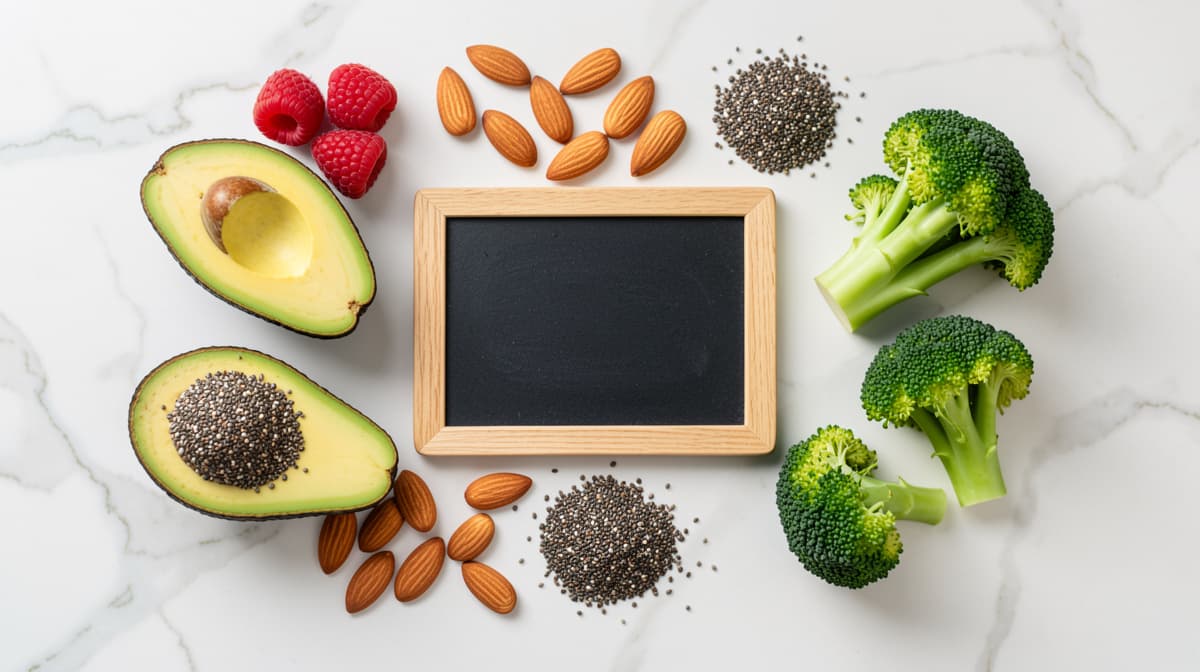
If you're eating keto or low carb, count net carbs — total carbs minus fiber minus (most) sugar alcohols — because fiber doesn't meaningfully raise blood glucose. If you have diabetes and dose insulin, total carbs is usually the safer starting point, and any switch to net carbs should happen with your clinician. The formula is simple; the judgment calls (especially around maltitol) are where most people get burned. Here's how to do the math correctly.
Quick comparison table
The gap between total and net carbs varies wildly by food. High-fiber whole foods look dramatically better on a net-carb basis; refined foods barely change. All values are USDA-typical, per 100 g:
| Food (per 100 g) | Calories | Total carbs | Fiber | Net carbs | Protein | Fat |
|---|---|---|---|---|---|---|
| Avocado | 160 | 8.5 g | 6.7 g | 1.8 g | 2.0 g | 14.7 g |
| Chia seeds | 486 | 42.1 g | 34.4 g | 7.7 g | 16.5 g | 30.7 g |
| Raspberries | 52 | 11.9 g | 6.5 g | 5.4 g | 1.2 g | 0.7 g |
| Broccoli (raw) | 34 | 6.6 g | 2.6 g | 4.0 g | 2.8 g | 0.4 g |
| Almonds | 579 | 21.6 g | 12.5 g | 9.1 g | 21.2 g | 49.9 g |
| Black beans (cooked) | 132 | 23.7 g | 8.7 g | 15.0 g | 8.9 g | 0.5 g |
| Apple | 52 | 13.8 g | 2.4 g | 11.4 g | 0.3 g | 0.2 g |
| White bread | 267 | 49.2 g | 2.7 g | 46.5 g | 9.4 g | 3.3 g |
Notice the pattern: an avocado's carbs are 79% fiber, so its net carbs are almost nothing. Chia seeds look scary at 42 g total carbs but land at under 8 g net. White bread, meanwhile, keeps 95% of its carbs either way. Net carbs reward whole, fibrous foods — which is a feature, not a loophole.
What's the formula for net carbs?
The standard calculation:
Net carbs = Total carbohydrates − Fiber − Sugar alcohols
On a US Nutrition Facts label, "Total Carbohydrate" already includes fiber and sugar alcohols (both are listed as indented sub-lines beneath it), so you subtract them out. That's the whole trick — and it's also where US and international labels diverge. In the UK, EU, and Australia, fiber is listed separately and "carbohydrate" on the label is already effectively net. If you're using a US label or the USDA database, you subtract; if you're reading a European label, you generally don't.
Two refinements the generic articles skip:
- Sugar alcohols aren't all equal. A conservative rule used by many dietitians: subtract erythritol and allulose fully, but only subtract half of other sugar alcohols (maltitol, sorbitol, xylitol, isomalt). More on why below.
- "Fiber" isn't always fiber. Some processed keto products use isomaltooligosaccharides (IMO) labeled as fiber, but studies show IMO is partially digested and raises blood glucose. If a bar's "fiber" is IMO, treat roughly half of it as real carbs.
For whole foods — vegetables, nuts, berries — the simple subtraction works fine. It's packaged products where you need the fine print.
Why doesn't fiber raise blood sugar?
Fiber is chemically a carbohydrate, but your body can't break it down the way it breaks down starch or sugar. Human digestive enzymes can't cleave the bonds in cellulose, pectin, and other fibers, so fiber never gets absorbed as glucose in the small intestine. No absorbed glucose, no blood sugar rise, no insulin response — which is the entire physiological argument for net carbs.
What actually happens to it: insoluble fiber (think celery strings, bran) passes through mostly intact. Soluble fiber (oats, psyllium, the pectin in berries) gets fermented by colon bacteria into short-chain fatty acids like butyrate. Those SCFAs do provide some energy — roughly 2 calories per gram versus 4 for digestible carbs — but they enter your metabolism as fat-like fuel, not glucose, and don't interfere with ketosis. Soluble fiber can even blunt the glucose response of the digestible carbs eaten alongside it by slowing gastric emptying, which is one reason 12 g of carbs from raspberries behaves nothing like 12 g from soda.
The honest caveat: "no glucose impact" is an approximation, not a law. Fermentation yields vary between people and fiber types, and a few semi-soluble "functional fibers" added to processed foods (soluble corn fiber, IMO) sit in a gray zone. For fiber that occurs naturally in whole foods, though, the subtraction is well supported.
When should you count net carbs — and when total?
Keto and low carb: count net. Nutritional ketosis typically requires about 20–50 g of net carbs per day (most people start around 20–25 g and find their personal ceiling from there). Counting total carbs at that threshold effectively punishes you for eating vegetables: a day with two cups of broccoli, half an avocado, and an ounce of chia would burn ~20 g of your total-carb budget on food that contributes maybe 8 g of usable glucose. Net carbs let you hit 20 g while still eating 25–35 g of fiber — better for satiety, digestion, and actually sustaining the diet. This is why CarbMeNot and most keto trackers default to net.
Diabetes, especially insulin users: start with total. The American Diabetes Association's consumer guidance points people to total carbohydrate on the label, and most insulin-to-carb ratios are calibrated against total carbs. Older ADA guidance allowed subtracting half the fiber when a serving contained 5 g or more, and some educators still teach that — but the key word is educator. If you dose insulin, changing your counting method changes your dose math, and that's a conversation for your clinician or CDCES, not a blog post. Undercounting via an optimistic net-carb label can mean underdosing and a post-meal spike.
General weight loss or flexible dieting: either works — just be consistent. The 5–15 g daily difference between methods rarely matters at 150+ g of carbs per day. Pick one, log it the same way every day, and let the trend data do its job.
The fair version of both sides: total-carb counting is more conservative and harder to game with label tricks; net-carb counting is more physiologically accurate for whole foods and makes very-low-carb diets livable. Neither is "wrong" — they're tools for different jobs.
What's the maltitol trap (and how do you do the label math)?
Sugar alcohols are the fine print that breaks the formula. They span a huge glycemic range: erythritol has a glycemic index of 0 (about 90% is absorbed but excreted unchanged in urine), xylitol sits around 13, sorbitol around 9 — but maltitol comes in at roughly 35, and maltitol syrup as high as 52. For reference, table sugar is 65. Maltitol also delivers 2–3 calories per gram. It is, functionally, half sugar — which is exactly why it's the cheapest and most common sweetener in "sugar-free" chocolate and old-school low-carb candy.
Walk through a real label. A "2 g net carb" keto-style bar, per 60 g serving:
- Total carbohydrate: 24 g
- Dietary fiber: 14 g
- Sugar alcohol (maltitol): 8 g
- Sugars: 2 g
The marketing math: 24 − 14 − 8 = 2 g net carbs. The physiological math, counting half of maltitol: 24 − 14 − 4 = 6 g net carbs — triple the front-of-package claim, and nearly a third of a 20 g daily keto budget from one bar. If that "fiber" is IMO rather than soluble corn fiber or chicory root, add back half of it too and you're near 13 g. Many people who stall on keto while eating "2 g net carb" treats are stalling on exactly this arithmetic.
Contrast with a bar sweetened with erythritol and allulose: 22 g total − 10 g fiber − 10 g erythritol = 2 g net, and that 2 g is believable, because erythritol genuinely doesn't register. Same front-of-pack claim, very different metabolic reality. Read the ingredient list, not the banner.
The bottom line
Use net carbs = total carbs − fiber − sugar alcohols if you're doing keto or low carb, targeting 20–50 g per day, and subtract only half of maltitol, sorbitol, and xylitol (erythritol and allulose subtract fully). Use total carbs if you dose insulin or manage diabetes, unless your care team explicitly moves you to a fiber-adjusted method. Whichever you choose, whole foods make the question nearly moot — the fiber in broccoli and avocados is exactly what net carbs were designed to forgive. The trap is packaged "keto" products, where a 2 g claim can hide 6–13 g of glucose-active carbs. A tracker that computes net carbs from real USDA data, rather than trusting the wrapper, closes that gap for you.
Frequently asked questions
- How do you calculate net carbs from a nutrition label?
- On a US label, take Total Carbohydrate and subtract Dietary Fiber and sugar alcohols: net carbs = total carbs − fiber − sugar alcohols. Subtract erythritol and allulose fully, but only half of maltitol, sorbitol, or xylitol, since they partially raise blood sugar. On UK/EU labels, the carbohydrate figure already excludes fiber, so no subtraction is needed.
- How many net carbs can you eat and stay in ketosis?
- Most people reach and maintain nutritional ketosis at 20–50 g of net carbs per day. A common approach is to start around 20–25 g, confirm ketosis over 2–4 weeks, then test your personal ceiling. Activity level, body size, and insulin sensitivity all shift the threshold, so two people on the same menu can get different results.
- Should people with diabetes count net carbs or total carbs?
- Total carbs is the safer default, and it's what the ADA's consumer guidance and most insulin-to-carb ratios are based on. Some educators allow subtracting half the fiber when a serving has 5 g or more, but if you dose insulin, changing your counting method changes your dose math — make the switch only with your clinician or diabetes educator.
- Do sugar alcohols really have zero carbs?
- No — only some behave that way. Erythritol (glycemic index 0) and allulose have essentially no blood sugar impact and can be fully subtracted. Maltitol has a GI of roughly 35 (up to 52 as syrup) and 2–3 calories per gram, so count about half of it. That's why 'sugar-free' maltitol chocolate can stall ketosis despite a low net-carb claim.
Keep reading
Free tools: Is It Keto? checker · macro calculator · protein calculator · 7-day meal plan PDF