Dark Meat vs White Meat Chicken: Nutrition Compared
Skinless chicken breast has 165 calories and 31g protein per 100g vs 179 calories and 24g for thigh. Both are zero-carb. Full dark vs white meat breakdown.

Editorial Team · July 2, 2026 · 7 min read
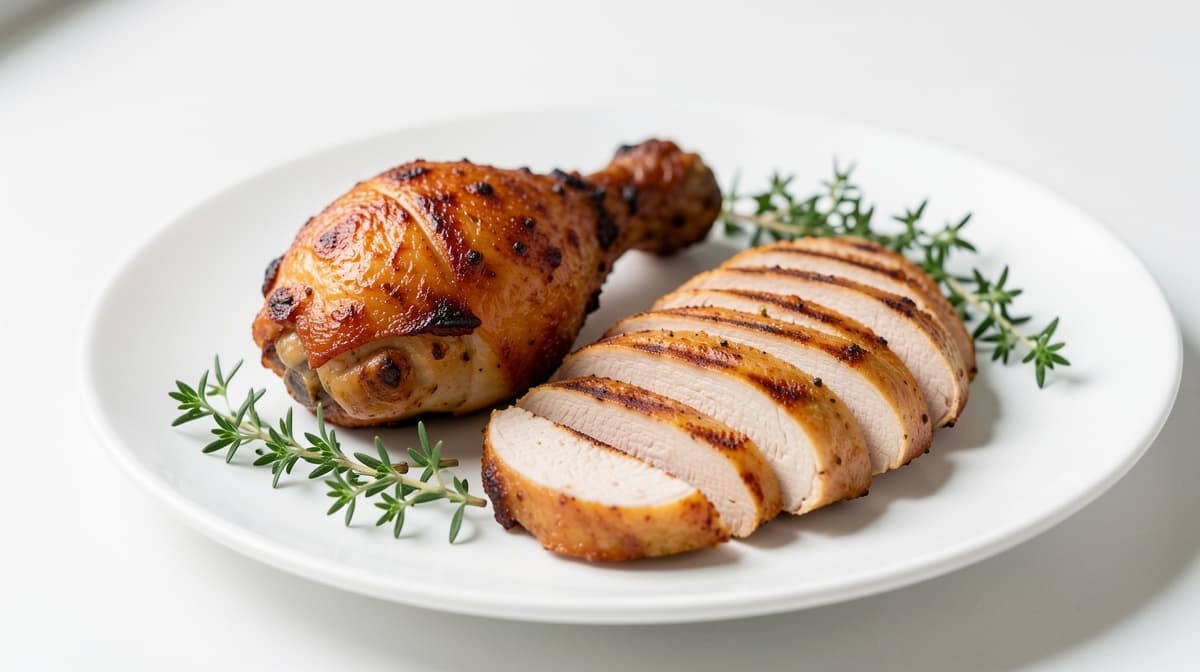
If you're deciding between chicken breast and chicken thigh, here's the short version: white meat wins on protein per calorie (31 g protein for 165 calories per 100 g of skinless breast), while dark meat wins on flavor, iron, zinc, and price — for a modest cost of about 15 extra calories and 5 extra grams of fat per 100 g. Both contain zero carbs, so on keto or low-carb, either one fits. The right pick depends on your goal, not on one being "healthy" and the other not.
Quick comparison table
Per 100 g (about 3.5 oz) of cooked, roasted chicken, USDA values:
| Cut (cooked) | Calories | Carbs | Fiber | Net carbs | Protein | Fat |
|---|---|---|---|---|---|---|
| Breast, skinless (white) | 165 | 0 g | 0 g | 0 g | 31 g | 3.6 g |
| Breast, with skin (white) | 197 | 0 g | 0 g | 0 g | 30 g | 7.8 g |
| Thigh, skinless (dark) | 179 | 0 g | 0 g | 0 g | 24 g | 9 g |
| Thigh, with skin (dark) | 247 | 0 g | 0 g | 0 g | 25 g | 15.5 g |
| Drumstick, skinless (dark) | 172 | 0 g | 0 g | 0 g | 27 g | 5.7 g |
Micronutrients tilt toward dark meat: a skinless thigh delivers roughly 1.1 mg of iron and 2.4 mg of zinc per 100 g, versus about 0.5 mg of iron and 1 mg of zinc in breast. White meat claws some back on B vitamins — breast is richer in niacin (B3) and B6, which matter for energy metabolism.
Since both cuts are zero-carb, the numbers that actually move on keto are protein and fat — and those depend on how much is on the plate. CarbMeNot logs a chicken dinner from a photo and adds its protein, fat, and calories to your daily targets.
Why is dark meat darker, and does it actually change the nutrition?
The color comes from myoglobin, an iron-containing protein that stores oxygen inside muscle cells. Muscles a chicken uses constantly and slowly — the legs and thighs it stands and walks on all day — are built from slow-twitch fibers that run on oxygen, so they're loaded with myoglobin and appear dark red-brown before cooking. The breast and wings power short, explosive flapping; those fast-twitch fibers burn glycogen instead of oxygen, need little myoglobin, and stay pale.
That physiology explains almost every nutritional difference. Oxygen-hungry muscle carries more iron (bound up in that myoglobin), more zinc, more taurine, and more intramuscular fat to fuel sustained work — which is why a skinless thigh has about 9 g of fat per 100 g versus 3.6 g in breast. The extra fat is also why dark meat tastes richer and stays juicy when you overshoot the cooking time. Fat carries flavor compounds, and dark meat's higher collagen content breaks down into gelatin during cooking, giving braised thighs that silky texture breast can never achieve.
One point the generic articles usually get wrong: dark meat's fat isn't mostly saturated. Of the ~9 g in a skinless thigh, roughly 2.5 g is saturated; the rest is mostly monounsaturated (the same family as olive oil's main fat) plus some polyunsaturated. Dark chicken meat is not the nutritional equivalent of fatty red meat — it's closer to breast with a drizzle of olive oil.
Which is better if you're cutting calories or chasing protein?
White meat, and it isn't close on efficiency. Skinless breast delivers 1 g of protein per 5.3 calories; skinless thigh delivers 1 g per 7.4 calories. Scale that up and it matters: to get 150 g of protein per day from breast alone costs about 800 calories, while the same protein from skinless thigh costs about 1,100. On an aggressive cut with a 1,600-calorie budget, that 300-calorie gap is a whole extra snack — or the difference between hitting your protein target and not.
Drumsticks are the underrated middle ground. Skinless drumstick meat runs about 172 calories with 27 g of protein per 100 g — nearly breast-level protein density with more dark-meat flavor and a lower price tag.
But calorie efficiency isn't the only variable in real life. Diets fail on boredom, and dry breast is where a lot of high-protein diets go to die. If thighs are what keep you eating chicken five nights a week instead of ordering pizza, the 15-calorie-per-100-g premium is the cheapest adherence insurance you can buy. And if you're on keto rather than counting calories, the math flips entirely: at 20-50 g of net carbs per day (net carbs = total carbs minus fiber minus sugar alcohols), you need fat to hit your energy needs, and thighs supply it without any added oil. Chicken of any color contributes exactly 0 g toward your carb limit — it's the marinade, breading, and sauce you have to log, not the meat.
Should you leave the skin on?
Depends on which number you're managing. Skin is roughly 40% fat by weight, and it adds up fast: keeping the skin on a thigh takes it from 179 to 247 calories per 100 g (+68 calories, +6.5 g fat), and skin-on breast rises from 165 to 197. Protein barely moves. If you're eating in a calorie deficit, skin is the single easiest thing to trim — removing it cuts a roast chicken dinner by 100-200 calories without changing the portion size at all.
If you're doing keto, the answer reverses. Skin has zero carbs, and its fat blend is about 55-60% unsaturated, so crispy skin is one of the few "indulgences" that costs you nothing against a 20-50 g net-carb budget while helping you reach your fat macro. The one trap: restaurant and packaged crispy skin is often dusted with flour or starch before frying. Plain roasted skin is 0 g net carbs; breaded skin is not.
A practical middle path: cook skin-on for flavor and moisture (the fat bastes the meat), then remove the skin at the table if calories are the priority. You keep most of the juiciness and lose most of the fat, since relatively little skin fat actually migrates into the meat during roasting.
Which is cheaper at the grocery store?
Dark meat, almost always, and by a wide margin. Typical U.S. supermarket prices put boneless skinless breast around $4-5 per pound, boneless skinless thighs around $3-4.50, bone-in thighs near $2-2.50, and drumsticks as low as $1.50-2 per pound. Breast is the most in-demand cut in America, so processors price it accordingly; legs are effectively the discount aisle of the same bird.
Run it per gram of protein and dark meat still usually wins despite its slightly lower protein content. Bone-in thighs at $2.25/lb work out to roughly 3 cents per gram of protein after accounting for bone; breast at $4.50/lb lands closer to 3.5-4 cents. Drumsticks are frequently the cheapest protein in the meat case, period. If you're feeding a family on a high-protein or keto budget, a tray of bone-in thighs plus ten minutes of knife work beats pre-trimmed breast every time — and the bones make free stock.
The price gap narrows for boneless skinless thighs, which carry a deboning premium, and occasionally inverts during sales, so it's worth checking both. But as a default rule: convenience and leanness cost money; flavor and iron are on discount.
The bottom line
There's no wrong answer here, only a wrong match to your goal. Choose white meat when protein per calorie is the priority — cutting weight, high protein targets, tight calorie budgets. Choose dark meat when you want more flavor, more iron and zinc, a lower grocery bill, or more fat to fill out keto macros. Both are 0 g net carbs, so neither touches your carb limit; log the sauce and breading, not the chicken. The strongest strategy is rotation: breast in stir-fries and salads where sauce carries the dish, thighs and drumsticks for roasting, braising, and grilling where the meat has to carry itself. Whichever you pick, weigh it cooked and log it — a "chicken thigh" can range from 50 to 150 g of meat, and that variance swamps the breast-vs-thigh difference on any given day.
Frequently asked questions
- Is dark meat chicken keto-friendly?
- Yes. Dark meat chicken has 0 g of carbs, so it contributes nothing toward a 20-50 g daily net-carb limit. Its higher fat content (about 9 g per 100 g in skinless thigh, 15.5 g with skin) actually makes it a better keto fit than breast, since keto relies on fat for most of its calories. Just watch marinades, breading, and sweet sauces — that's where the carbs hide.
- Does white meat really have more protein than dark meat?
- Per 100 g cooked, skinless breast has about 31 g of protein versus 24 g in skinless thigh — and because breast is also lower in calories (165 vs 179), it delivers roughly 40% more protein per calorie. Skinless drumstick is a strong middle option at about 27 g of protein per 100 g.
- Why is dark meat darker than white meat?
- Dark meat is dark because of myoglobin, an iron-rich oxygen-storing protein. Leg and thigh muscles work continuously, so they're built from oxygen-dependent slow-twitch fibers packed with myoglobin, fat, iron, and zinc. Breast muscles power short bursts of flapping, use little oxygen, and stay pale and lean.
- Is dark meat chicken cheaper than white meat?
- Usually, yes. Typical U.S. prices run about $4-5 per pound for boneless skinless breast versus $2-2.50 for bone-in thighs and as little as $1.50-2 for drumsticks. Even adjusting for bones and slightly lower protein, dark meat generally costs less per gram of protein, making it one of the cheapest proteins in the store.
Keep reading
Free tools: Is It Keto? checker · macro calculator · protein calculator · 7-day meal plan PDF