Butter vs Margarine: Which Is Actually Better for You?
For LDL cholesterol, modern tub margarine beats butter (~2g vs 7g saturated fat per tbsp); for keto and whole-food cooking, butter wins. Trans fat is gone.

Editorial Team · July 2, 2026 · 7 min read
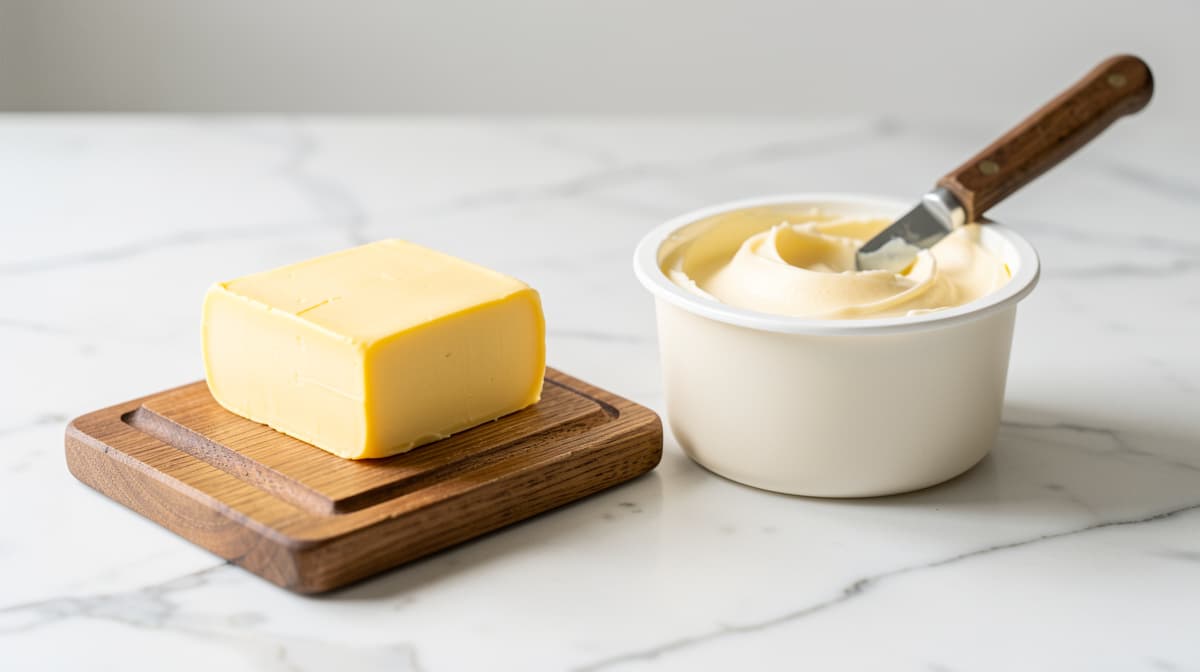
Neither butter nor margarine deserves its reputation — good or bad. If your main concern is LDL cholesterol, a modern soft tub margarine made from liquid vegetable oils beats butter: swapping one for the other typically drops LDL by around 10%. If you prioritize minimal processing, flavor, and keto-friendly cooking, butter wins. The old anti-margarine argument — trans fat — is essentially dead: the FDA banned partially hydrogenated oils in 2018. Small amounts of either fit a healthy diet.
Quick comparison table
USDA-typical values per 100 grams. One tablespoon is about 14 grams, so divide by seven for per-serving numbers.
| Calories | Total carbs | Fiber | Net carbs | Protein | Total fat | Saturated fat | |
|---|---|---|---|---|---|---|---|
| Butter, salted | 717 | 0.1 g | 0 g | 0.1 g | 0.9 g | 81 g | 51 g |
| Stick margarine (80% fat) | 717 | 0.7 g | 0 g | 0.7 g | 0.2 g | 81 g | ~15 g |
| Tub vegetable-oil spread (~60% fat) | 533 | 1 g | 0 g | 1 g | 0.2 g | 60 g | 8–14 g |
| Light spread (~40% fat) | 360 | 1 g | 0 g | 1 g | 0.3 g | 40 g | 5–8 g |
Per tablespoon, that's roughly 102 calories and 7.2 g saturated fat for butter versus about 80 calories and 1.5–2.5 g saturated fat for a typical tub spread. Both are effectively zero-carb foods; the carb difference is a rounding error. Saturated fat in spreads varies widely with palm oil content, so check the label — some "buttery" tubs run higher than you'd expect.
Is butter's saturated fat really the problem?
Butter is about 63% saturated fat, and that's the core of the case against it. Saturated fat reliably raises LDL cholesterol, and LDL is causally linked to heart disease — that part isn't seriously contested. A 2020 Cochrane review of randomized trials found that cutting saturated fat reduced combined cardiovascular events by about 17%, with the benefit strongest when it was replaced by polyunsaturated fat rather than refined carbs. That last clause matters: in the 1990s, plenty of people swapped butter for fat-free crackers and got nothing for it.
The honest counterpoint: the picture is messier than "butter clogs arteries." Some large observational analyses (including a 2016 meta-analysis covering over 600,000 people) found butter itself had only small or neutral associations with heart disease and mortality. Dairy fat may behave differently than the same fatty acids in processed meat, and butter contributes vitamin A (about 97 mcg RAE per tablespoon), vitamin K2, and small amounts of butyrate and CLA. But "not as bad as feared" isn't the same as "beneficial." Major bodies — the AHA, WHO, and the Dietary Guidelines — still recommend keeping saturated fat under 10% of calories (the AHA says 6% for people with high LDL), and a couple of tablespoons of butter gets you most of the way there on its own. If your LDL runs high, butter is one of the easiest levers to pull.
Didn't trans fat make margarine worse than butter?
It did — past tense. Old-school stick margarine was made by partially hydrogenating vegetable oil, which created industrial trans fat, the one fat with no safe intake level. It raises LDL, lowers HDL, and drove the "margarine is worse than butter" era; some vintage sticks carried 2–3 g of trans fat per tablespoon. That product no longer legally exists in the US. The FDA revoked the GRAS status of partially hydrogenated oils in 2015, with compliance required by 2018 and the last inventory gone by early 2020. Today's margarines are made from liquid oils firmed up with palm fat, full hydrogenation (which paradoxically produces zero trans fat), or interesterification.
The fair modern critique of margarine isn't trans fat — it's processing. By the NOVA classification, margarine is an ultra-processed food: refined oils, emulsifiers like mono- and diglycerides, added colors and flavors, sometimes plant sterols. Butter is minimally processed — churned cream and salt. If you follow a whole-foods philosophy, butter is the more defensible ingredient. The counter-counterpoint: "ultra-processed" is a broad bucket, and a soft spread made mostly from olive or canola oil has little in common with soda or packaged snack cakes. In trials, these spreads do what the label promises: lower LDL versus butter, with sterol-fortified versions (Benecol, plant-sterol spreads) cutting LDL an additional 7–10% at 2 g sterols per day. Judge the specific product, not the category. A short ingredient list built on olive or avocado oil is a genuinely reasonable food.
What about the seed oil and omega-6 debate?
Most margarine is built on soybean, canola, or sunflower oil, and "seed oils are inflammatory" is one of the loudest claims in nutrition right now. The concern: these oils are high in linoleic acid (an omega-6 PUFA), our omega-6 intake has climbed dramatically, and omega-6 is a precursor to some pro-inflammatory signaling molecules.
Here's what controlled evidence actually shows. Randomized trials that raised linoleic acid intake generally did not increase inflammatory markers like CRP or IL-6 — a systematic review of 15 RCTs found essentially no effect. Higher blood levels of linoleic acid are associated with lower, not higher, rates of diabetes and cardiovascular disease in pooled cohort studies. The 2017 AHA presidential advisory came down firmly on the side of replacing saturated fat with these oils.
The skeptics keep two legitimate points, though. First, a couple of older trials (like the re-analyzed Minnesota Coronary Experiment) muddy the intervention evidence, even if the overall trial pool still favors PUFA. Second, seed oils oxidize when repeatedly heated to high temperatures — a real issue for restaurant deep-fryer oil, far less relevant to a tablespoon of tub spread on toast. Where most omega-6 actually enters the American diet is fried food and packaged snacks, not margarine. If seed oils worry you, olive-oil-based spreads and butter both sidestep the question; just don't let the debate distract from the fried-food elephant in the room.
Which fits keto — and which cooks better?
On the numbers, both fit easily. Keto typically means 20–50 g of net carbs a day (net carbs = total carbs − fiber − sugar alcohols), and butter contributes essentially zero while most margarines add under 1 g per 100 g. Butter is a keto staple for good reason: pure fat, zero net carbs, and no ingredient list to audit. Tub margarines pass the macro test too, but quality varies — some light spreads pad the water content with maltodextrin or milk solids, and at 40% fat they deliver less of the energy a keto diet is actually built on. If you're tracking in CarbMeNot, either logs as a near-zero-carb fat; the decision is about fat quality, not carbs. One nuance: many people go keto partly to raise fat intake deliberately, and if that fat skews heavily saturated, LDL can climb — worth checking labs rather than guessing.
In the kitchen, the differences are bigger. Butter's milk solids burn around 302°F (150°C), so it's for medium-heat sautéing, finishing, and baking — where its 80% fat and flavor are irreplaceable. Ghee or clarified butter removes the solids and handles roughly 450°F (232°C). Stick margarine at 80% fat bakes almost interchangeably with butter; tub spreads don't — their 20–40% water content sputters in a hot pan and wrecks cookie and pastry texture. For high-heat searing, skip both and use avocado or light olive oil.
The bottom line
For heart health, the evidence favors a soft, trans-fat-free tub spread built on liquid oils — or better yet, olive oil where it works. For whole-food eating, baking, flavor, and keto simplicity, butter is the better ingredient, used within a saturated-fat budget of roughly 13–22 g per day for most adults. The worst option — stick margarine loaded with trans fat — was regulated out of existence in 2018. Pick based on your LDL numbers and your cooking, not on decades-old headlines about either one.
Frequently asked questions
- Does margarine still contain trans fat?
- No — not in the US. The FDA revoked approval of partially hydrogenated oils (the source of industrial trans fat) in 2015, with compliance required by 2018 and remaining inventory gone by early 2020. Modern margarines are firmed with palm oil, fully hydrogenated oil, or interesterified fats instead, all of which are trans-fat-free. If you see 'partially hydrogenated' on any ingredient list, skip it, but you almost never will anymore.
- Is butter OK on a keto diet?
- Yes — butter is one of the cleanest keto fats available. It has essentially 0 g net carbs, about 102 calories and 11.5 g of fat per tablespoon, and a two-ingredient label (cream, salt). Most tub margarines also fit keto macros at under 1 g of carbs per 100 g, but check light spreads for fillers like maltodextrin. If keto pushes your saturated fat intake up sharply, it's worth monitoring your LDL cholesterol with bloodwork.
- Which is better for lowering cholesterol, butter or margarine?
- Margarine — specifically a soft tub spread made from liquid vegetable oils. Butter delivers about 7.2 g of saturated fat per tablespoon versus roughly 1.5–2.5 g in typical tub spreads, and replacing butter with these spreads lowers LDL by around 10% in controlled studies. Spreads fortified with plant sterols (about 2 g per day) cut LDL an additional 7–10%. Olive oil remains the strongest choice overall where a liquid fat works.
- Which is better for cooking and baking?
- It depends on the job. Butter is best for baking and medium-heat cooking but its milk solids burn around 302°F; ghee (clarified butter) handles about 450°F. Stick margarine at 80% fat bakes nearly interchangeably with butter. Tub spreads are 20–40% water, so they sputter in hot pans and ruin pastry texture — keep them as spreads. For high-heat searing, avocado or light olive oil beats both.
Keep reading
Free tools: Is It Keto? checker · macro calculator · protein calculator · 7-day meal plan PDF